Watch Series Online

Ink Review: Danny Boyle’s Venice Opener Is a Blistering Triumph
The fireworks at this year’s Venice Film Festival didn’t wait for the awards ceremony. They arrived on opening night, when Danny Boyle’s Ink — a ferocious origin story about Rupert Murdoch’s takeover of the British tabloid The Sun — unspooled in the packed Sala Grande and drew a warm four-minute ovation. Within hours, a festival-wide consensus was forming: this is Boyle’s most electrifying film in years, a propulsive and queasily entertaining portrait of how the modern media learned to sell outrage by the truckload.
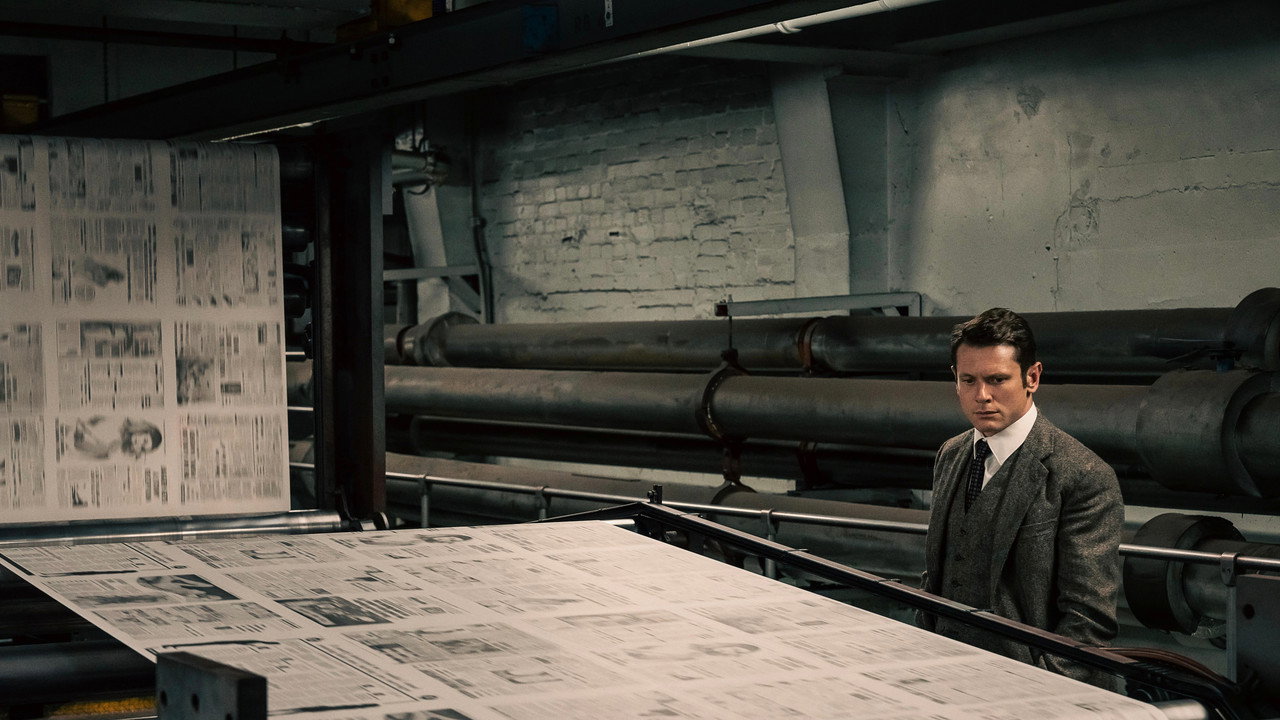
Table of Contents
What Is Ink About?
The film, adapted by James Graham from his own award-winning 2017 stage play, drops us into Fleet Street in 1969. A young Rupert Murdoch, freshly in control of the struggling The Sun, recruits a volcanic Yorkshire newspaperman named Larry Lamb and hands him a simple mandate: beat the Daily Mirror and make the paper matter. Lamb takes the brief with terrifying enthusiasm, assembles a band of misfits and cast-offs — including Jules Davies, the paper’s new women’s editor and his sometime mistress — and begins tearing up every rule of British journalism along the way.
What follows is less a stately period drama than a heist movie about the birth of the modern tabloid. Boyle and cinematographer Alwin H. Küchler shoot the early scenes like a caper, all canted angles and dizzying zooms, while Daniel Pemberton’s score and a bristling punk soundtrack keep the pedal down. The story charts Lamb’s rise as The Sun climbs the circulation charts, selling sex, celebrity and scandal with a populist zeal that its owner watches with a mixture of pride and queasiness. It’s gripping, funny, and deeply unsettling — often all at once.
A Cast Firing on All Cylinders
Jack O’Connell, who broke through as troublemaking teen James Cook in the UK hit Skins before proving his range in Unbroken, is magnetic as Lamb: charming, ruthless, and convinced that giving the people what they want is a kind of justice. Opposite him, Guy Pearce plays Murdoch with oily finesse — an Aussie outsider sneering at the English establishment while building the machine that will one day tower over it. Pearce, a veteran of mind-bending thrillers like Memento and the neo-noir classic L.A. Confidential, has quietly become one of the most reliable character actors of his generation, and his Murdoch — by turns charming, calculating and faintly chilling — looks like a career highlight. Critics have called the pairing the film’s engine, and it’s hard to disagree.
Claire Foy, fresh off her celebrated reign as Queen Elizabeth II in The Crown, brings steel and wit to Jules Davies, a fictionalized composite character who starts as Lamb’s most loyal lieutenant and slowly becomes the story’s conscience. The supporting cast is stacked with British character actors, including Bertie Carvel, Brian Gleeson, Patrick Kennedy and Jonathan Hyde, each adding texture to a newsroom that feels both gloriously alive and quietly doomed.
What the Critics Are Saying
The reviews out of Venice have been strikingly strong. As of early September the film sits at 85% on Rotten Tomatoes, with Variety’s Guy Lodge calling it “a gripping, sizzling tabloid drama” and hailing O’Connell as “superb.” Screen Daily says the actor is “magnetic” as Lamb, while the Guardian describes a “lurid tabloid frenzy” that turns the paper’s origin story into grand entertainment. The highest praise comes from Vulture’s Bilge Ebiri, who argues that Ink is “Danny Boyle’s best film in decades” — a comparison that lands somewhere between Trainspotting and Citizen Kane, with the same restless energy that made Boyle’s 1996 breakthrough a cultural earthquake.
None of this is accidental. Netflix bought U.S. and Latin American rights back in July, and the Venice opener was always going to be the throwing-down-the-gauntlet moment — the first salvo in what the streaming giant hopes will be a long awards-season campaign. A strong circuit run through Telluride, Toronto and London only sharpens the picture: Boyle’s last Oscar glory came with Slumdog Millionaire in 2009, and there’s a real chance he’s back in that conversation.
The film doesn’t flinch from its subject’s uglier echoes, either. A key thread follows the 1969 kidnapping of Muriel McKay, wife of one of Murdoch’s top executives, mistaken for Murdoch’s own wife by her abductors — an episode Lamb initially treats as glorious headline fodder, to his colleagues’ horror. It’s the moment the movie’s candy coating starts to burn off, and it sets up the closing montage that connects The Sun‘s legacy to everything from Fox News to the social-feed clickbait economy we swim in today.
Why This Story Still Echoes
At its heart, Ink is about a question that never went away: what happens when the people who feed us information decide that engagement beats truth? Lamb’s mantra — “People need stories” — sounds almost innocent in 1969; half a century later it reads like a mission statement for the algorithm age. The movie invites you to enjoy the ride and then makes you sit with the bill, much like the best media-family dramas from Succession to The Social Network. It’s the rare film that is simultaneously a blast to watch and a warning about what we’re watching. Part of what makes it work is the material’s journey: Graham’s play was a hit on the London stage before Boyle came calling, and the movie keeps the theatrical snap of that source material — crackling dialogue, heightened scenes, a newsroom that moves like a chorus — while adding the visual fireworks only cinema can supply. It’s a rare example of a stage hit surviving the trip to the screen with its teeth intact.
There’s also a through-line in Boyle’s own career worth noting. The director has spent the last few years cycling through British history and iconography — the post-apocalyptic dread of 28 Years Later, the punk chaos of his Pistol miniseries — and Ink feels like the sharpest expression yet of that obsession with how nations tell their own stories. With it, he’s vaulted himself back into the awards conversation.
When and Where to Watch
Ink premiered in competition for the Golden Lion at Venice, and continues its festival run at Telluride, Toronto and London before hitting theaters. It opens in select U.S. theaters on December 11, 2026, lands on Netflix in the U.S. and Latin America on January 8, 2027, and gets a U.K. and Irish theatrical release from StudioCanal the same day. French audiences get it on January 6, with Australia, Belgium, the Netherlands and New Zealand following on January 7.
If festival buzz is any guide, this one is worth clearing your calendar for — and it’s a reminder that Boyle, even at the top of his game, still makes movies that feel like they might tear the screen apart. Whether you’re in it for the performances, the history, or just the sheer adrenaline of a master filmmaker in full flight, Ink is shaping up as one of the most essential releases of the season. Are you planning to catch it in theaters or wait for the Netflix drop?
© Telepisodes [EST 2008 - 2018] Disclaimer | Sitemap | About | Blog | Use of this website constitutes acceptance of Telepisodes' Terms of Service and Privacy Policy.