Watch Series Online

Colman Domingo Roasts Elon Musk’s ‘Historically Accurate’ AI The Odyssey Pitch: ‘He Means Whiter Than Christmas at Cracker Barrel’
Colman Domingo has never been one to hold back, and during a recent talk show appearance, the Emmy-winning actor delivered what might be the burn of the summer — aimed squarely at Elon Musk and his bizarre proposal to create a “historically accurate” AI-generated version of The Odyssey.
“By historically accurate, he means whiter than Christmas at Cracker Barrel,” Domingo said, drawing roars of laughter from the audience. The comment came after Musk took to social media to float the idea of using artificial intelligence to produce an alternative take on Homer’s ancient epic — one that would supposedly correct the historical inaccuracies of Christopher Nolan’s blockbuster adaptation, which recently shattered box office records worldwide.
Domingo’s razor-sharp quip instantly went viral, racking up millions of views across social media platforms and sparking a broader conversation about AI’s role in Hollywood, the politics of representation in historical epics, and the sheer audacity of a tech billionaire trying to one-up one of the most celebrated filmmakers of the 21st century.
Table of Contents
The Context: Nolan’s The Odyssey Is Dominating the Box Office
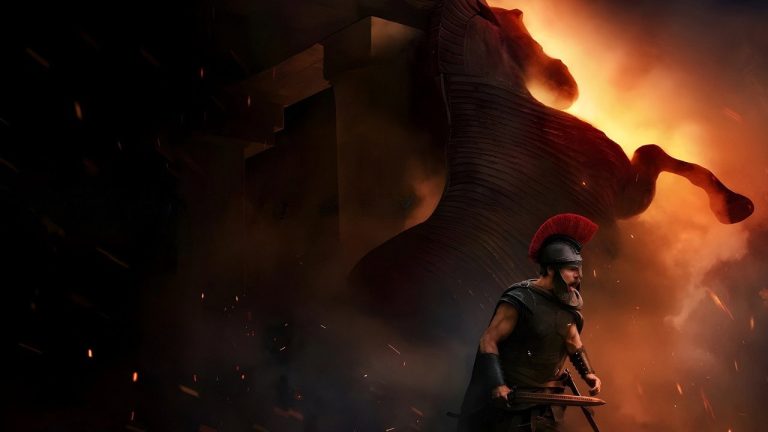
To understand why Domingo’s jab landed so hard, you have to look at the numbers. Christopher Nolan’s The Odyssey — starring Matt Damon as Odysseus, with a star-studded cast including Zendaya, Tom Holland, and Lupita Nyong’o — opened to a staggering $124 million domestically and $264 million worldwide, becoming one of the biggest openings of Nolan’s career. The film has been a critical triumph as well, with praise for its sweeping visual storytelling, practical effects, and a diverse cast that reflects the multicultural ancient world that scholars have long argued was far more varied than Hollywood traditionally depicted.
This is the film Musk took aim at. In a series of posts on his platform X, the billionaire suggested that AI could be used to generate a “historically more accurate” version of The Odyssey — a version that would, in his view, better represent the ancient Greek world. Critics and observers were quick to note that what Musk actually seemed to object to was the presence of actors of color in a story set in the ancient Mediterranean, a region that historical and archaeological evidence confirms was a crossroads of Africa, Europe, and Asia.
Colman Domingo: The Perfect Voice for the Moment
Domingo, best known for his Emmy-winning role in Euphoria and his Oscar-nominated work in Rustin, has emerged as one of Hollywood’s most articulate and unflinching voices on issues of representation. His “whiter than Christmas at Cracker Barrel” line cuts to the heart of the matter: the idea that a “historically accurate” version of an ancient story would somehow be whiter than Nolan’s already predominantly white cast is, as Domingo put it, nonsense wrapped in tech-bro jargon.
“These ancient civilizations were melting pots,” Domingo told the host. “They traded with Africa, they fought with Asia, they had people from all over the known world. If you want ‘historically accurate,’ you need to look at the scholarship, not a tweet from a guy who thinks algorithmically generated content is the same as art.”
Domingo’s comments have been widely shared and praised, with many noting the irony of a billionaire who didn’t invent AI using AI to complain about a movie made by an actual artist.
The AI Angle: What Would an AI-Generated Movie Even Look Like?
Musk’s proposal also raises a more fundamental question: can AI even make a movie like The Odyssey? The answer, according to virtually everyone in the industry, is no — at least not in any meaningful sense. AI-generated video is rapidly improving, but it remains a far cry from the practical effects, human performances, and directorial vision that make Nolan’s films unique. Oppenheimer, Nolan’s previous film, won seven Academy Awards largely because of its commitment to practical filmmaking, real explosions, and actors delivering career-best performances in camera — none of which AI can replicate.
What Musk seems to be proposing isn’t a movie in any traditional sense but a piece of generative media: images and video stitched together by algorithms based on text prompts. It’s the same technology behind Runway’s recently launched Media Router and other AI video tools that have stirred controversy in Hollywood. But a tech demo is not a film, and a generated sequence is not a performance.
The Bigger Picture: Hollywood vs. Silicon Valley Culture War
The Domingo-Musk exchange is the latest flashpoint in an escalating culture war between the entertainment industry and the tech sector over AI. Earlier this month, the Art Directors Guild called out Martin Scorsese over AI comments. Netflix paid $587 million for Ben Affleck’s AI filmmaking startup InterPositive. And every major studio is grappling with how to integrate — or resist — generative AI tools.
But this particular clash feels different because it’s personal. Musk didn’t critique The Odyssey on artistic grounds; he proposed replacing it with a machine-made alternative. That struck a nerve not just with Domingo but with working actors, writers, and directors who see AI not as a tool but as an existential threat to their craft.
As Domingo put it in a follow-up post: “Art isn’t a spreadsheet. You can’t optimize for historical accuracy the way you’d optimize a supply chain. Movies are made by humans, for humans. That’s the whole point.”
What Happens Next
Nolan’s Interstellar and Tenet continue to have passionate fanbases, and The Odyssey is on track to become one of the highest-grossing films of the year. Musk, meanwhile, has not responded directly to Domingo’s Cracker Barrel comment — perhaps wisely. The exchange has become a defining moment in Hollywood’s AI debate, crystallizing the stakes in a way that industry panels and think pieces could not.
Whether or not Musk ever actually produces an AI-generated Odyssey — and most observers doubt he will — the conversation he started has already revealed deep fault lines. On one side: technology, automation, and the promise of infinite content. On the other: artistry, human performance, and the messy, beautiful imperfections that make movies worth watching.
Colman Domingo, for his part, is not worried. “Let him try,” he said with a grin. “I’ll bring the popcorn.”
Why This Matters for Streaming and TV
While the immediate drama is centered on a theatrical release, this clash has ripple effects across the entire entertainment landscape. Streaming platforms — Netflix, Amazon Prime Video, Disney+, HBO Max — are all racing to figure out their AI strategies. Netflix’s $587 million acquisition of Ben Affleck’s InterPositive signaled that the streaming giant sees AI not as a threat but as a tool. Meanwhile, Amazon is bundling Luna cloud gaming into Prime Video, blurring the lines between passive viewing and interactive entertainment even further.
The question of who gets to tell stories — and how — is more urgent than ever. If a billionaire can propose replacing a studio film with an AI-generated alternative and be taken seriously, then every creative professional in Hollywood has a stake in the outcome. The Domingo-Musk exchange wasn’t just a funny moment on late-night television. It was a declaration that art made by humans still matters. And in an industry increasingly obsessed with algorithms, engagement metrics, and content efficiency, that reminder is worth more than any box office record.
© Telepisodes [EST 2008 - 2018] Disclaimer | Sitemap | About | Blog | Use of this website constitutes acceptance of Telepisodes' Terms of Service and Privacy Policy.